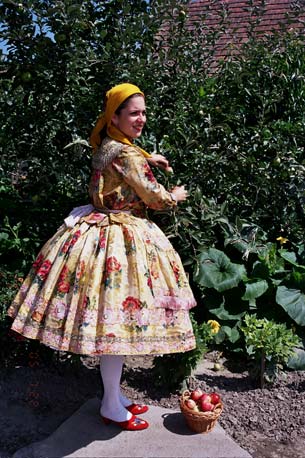
Hungarian Gypsies
Others schools of thought counsel that Hungarians have a Sumerian/Iranian origin. Genetically and optically, one can not clearly differentiate the attention colours of people in Hungary as a result of Hungary has a mixed population, and with the eye colors of no vital difference. Even by pictures, it’s exhausting to get a general consensus as some put on coloured contact lenses. The average eye colour of the Hungarian could also be difficult to determine because Hungary is a very ethnically numerous nation.
of essentially the most thoughts-blowing architectural spots in Budapest
In certain counties right now, especially within the northeastern nook of the nation (Szabolcs-Szatmár, Hajdú-Bihar, Borsod-Abaúj-Zemplén, Heves, Nógrád and Béokés) the Gypsy population is already near 10%. This method of writing names is not used for people who are not Hungarian (or not from one other country where Eastern title order is used). However, names of historic importance are generally translated and written within the Hungarian means, e.g. Names from languages using a different script (Arabic, Chinese, Cyrillic, Greek, and so forth.) are transcribed according to pronunciation.
The legend of dobos torte started in 1885, when the Hungarian confectioner József C. Dobos launched his pioneering cake on the National General Exhibition of Budapest. Dobos torte is among the most outstanding Hungarian dishes, made from sponge cake layered with chocolate buttercream and topped with caramel. The primary ingredient, the buttercream, was unknown and was used for the very first time. Dobos stored his recipe secret till his retirement, though now dobos torte has many more variations. The Hungarian language is part of the Finno-Ugrian language household and regarded as one of the most difficult languages on the earth to study.
On 26 May 2010, Hungary’s Parliament passed a invoice granting twin citizenship to ethnic Hungarians living outdoors of Hungary. Some neighboring countries with sizable Hungarian minorities expressed concerns over the legislation. From the upper Tisza area of the Carpathian Basin, the Hungarians intensified their looting raids throughout continental Europe.
In truth, Hungarian comes from the Ularic region of Asia and belongs to the Finno-Ugric language group, that means its closest relatives are literally Finnish and Estonian. Soviet forces invaded Hungary in late 1944, finding a devastated nation and a decimated inhabitants.
Recent genetic analysis is according to the previous archaeological and anthropological assumptions that the unique Hungarian conqueror tribes have been associated to the Onogur-Bulgars. A substantial a part of the conquerors show similarities to the Xiongnu and Asian Scythians and presumably this Inner Asian part on their way to Europe combined with the peoples of the Pontic steppes. According to this examine the conqueror Hungarians owned their principally Europid characteristics to the descendants of the Srubnaya culture. For historic reasons (see Treaty of Trianon), significant Hungarian minority populations could be found in the surrounding countries, most of them in Romania (in Transylvania), Slovakia, and Serbia (in Vojvodina). Sizable minorities reside also in Ukraine (in Transcarpathia), Croatia (primarily Slavonia), and Austria (in Burgenland).
There are more than 1,000 pure springs in the country (and the world’s largest thermal lake at Hévíz, close to Lake Balaton), with 118 in Budapest alone. By Air – International airways operating from Hungary are Aeroflot, Air France, British Airways, Easy Jet, KLM, Lufthansa, Sky Europe, Swiss, United Airlines and Wizz Air. Budapest Ferihegy International Airport in Hungary is the largest airport on the earth about ten kilometers southeast of Budapest. The Hungarians traveled on horseback to Europe and even at present cowboys may be seen in the plains of Puszta. History explains intimately that in the course of the defeat of the Hungarian Revolution of 1848 against the Habsburgs, about thirteen Hungarian generals were executed, and the Austrians who defeated them toast their beer glasses after each execution.
A 12 months later, the Communist Party took energy and the Hungarian Soviet Republic was declared, although by 1920 energy was restored to the monarchy and the country was a parliamentary democracy. Hit hard by the Great Depression and with WWII looming, the country once more fell victim to autocratic tendencies, leading to it becoming a member of forces with the Axis powers and coming into the conflict.
Endonym of the ethnic group and nation
Hungarians are a nation of horsemen as a result of their ancient nomadic past, and guests usually receive an invite to go riding from their new native friends. Hospitality is a significant part of the tradition right here, and private questions about your life are all a part of the getting-to-know-you course of. By the early 16th century, Hungary misplaced its worldwide significance due to weak kings and peasant unrest, and a revolt in 1514 gave the Ottoman Turks the momentum they wanted at the Battle of Mohacs in 1541. Hungary was divided into three, and the Turks remained in management till the late seventeenth century, when a joint military generally known as the Holy League recaptured the Buda region and went on to reclaim the nation for its folks in 1717.
Elvis Presley is an honorary citizen of Budapest
Later, the territory of the medieval Kingdom of Hungary included that of former Pannonia, and Medieval Latin transferred the denomination of Pannonia to the territory of the Kingdom of Hungary. Further, the King of Hungary was given the title of Rex Pannoniae («King of Pannonia») and Rex Pannonicorum («King of the Pannonians»). «Iuhra», «the place of birth of Hungarians» (inde ungaroru origo) on Sigismund von Herberstein’s map of AD 1549 of Moscovia, situated east of the Ob River. This number is a decrease estimate, as 405,261 individuals (7.5% of the entire population) didn’t specify their ethnicity on the 2011 Slovak Census.
Those who had no direct participation within the political life on national [parliamentary] or native [counties] level (like the common individuals of the cities, towns, or the peasantry of the villages) were not considered a part of the Natio Hungarica. This previous medieval origin conference was additionally adopted formally within the Treaty of Szatmár of 1711 and the Pragmatic Sanction of 1723; remained until 1848, when the Hungarian nobility was abolished; and thereafter acquired a way of ethnic nationalism. An autosomal evaluation, learning non-European admixture in Europeans, discovered four.4% of admixture of non-European and non-Middle Eastern origin amongst Hungarians, which was the strongest amongst sampled populations. It was discovered at 3.6% in Belarusians, 2.5% in Romanians, 2.three% in Bulgarians and Lithuanians, 1.9% in Poles and 0% in Greeks. In the 19th century, the proportion of Hungarians within the Kingdom of Hungary rose steadily, reaching over 50% by 1900 due to higher natural progress and Magyarization.
The origins of Hungarians, or Magyars as they call themselves, is a topic of heated debate and fantastical theories abound. Most experts agree that the Magyar tribes originated someplace between the Volga River and the Ural Mountains in current day Russia.
The origin of Hungarian names is closely associated to the spiritual and dynastic history of the nation. Occasionally there are greater than one of the latter, however normally only one is used. In the Hungarian language, whether or not written or spoken, these names are invariably given in the «Eastern identify order», or family title adopted hungarian women by given name (in overseas-language texts, names are sometimes given with the household name last). The Hungarian language is likely one of the few national languages in Europe to use the Eastern title order, amongst languages like Chinese, Japanese, Korean, and Vietnamese and a few Basque nationalists.
